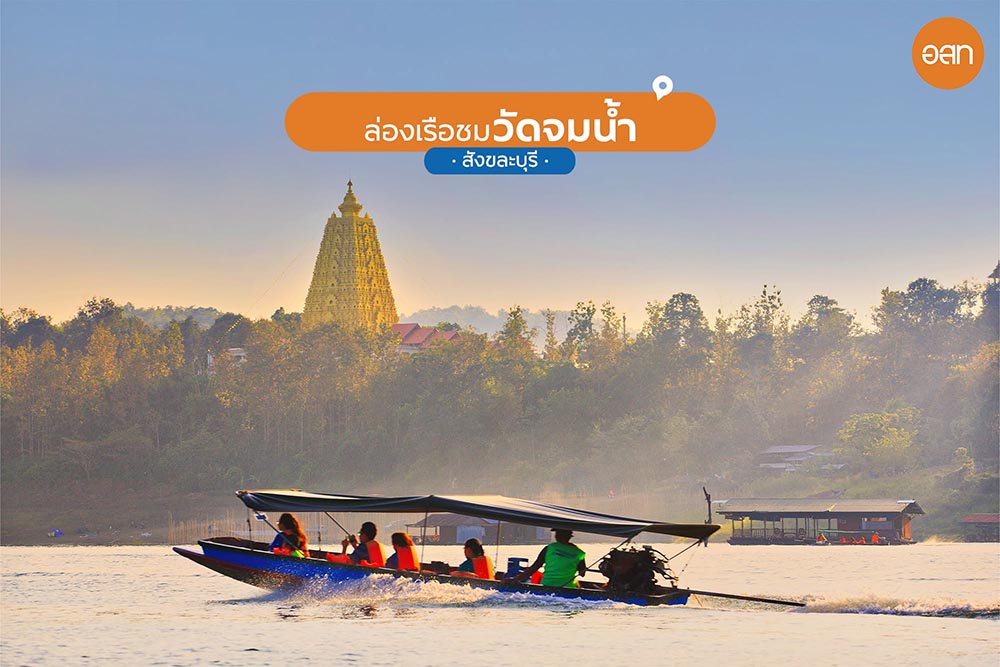
Activities: Boat trip to the submerged temple and Mon Bridge, Sangkhlaburi | Kanchanaburi
Details
🛕 If you're in Sangkhlaburi and don't take a boat trip to the submerged temples, it would be a real shame! They're incredibly beautiful. If you go at the right time, you can even walk down to the temples. But if the tide is high, you'll have the chance to see something even more amazing.
🗺️ There are about 4 boat routes to choose from for visiting the submerged temples. You can contact boat operators at the pier on both the Mon and Thai sides.
1️⃣ Route 1: 1 temple, 300 baht.
2️⃣ Route 2: 3 temples, 500 baht.
3️⃣ Route 3: 3 temples and the old city gate, 1,200 baht.
4️⃣ Route 4: 3 temples, the old city gate, and the Japanese Cliff, 1,500 baht.
👌 Now that you're here, choose your route! You should visit at least 3 temples, and the rest depends on your time. But if you get a chance to visit the "Old City Gate," the boatman has an interesting story to tell. He said that in the past, the rock face at the old city gate wasn't as wide as it is now; it was just a small gap used for migration across the border. This wide area was likely bombed during World War II.
📿High on the cliff is the shrine of the City Gate Guardian Spirit, or Phra Pu U Chi Maung, revered by the locals. Visitors often bring brooms to clean the area. Nearby, there are statues of King Naresuan the Great and Princess Suphankanlaya, evidence that this area was a route used by both Burmese and Thai armies.
If the water level is high enough and you have the chance to reach "Japanese Cliff," it's well worth the visit. Japanese Cliff features Japanese-style Buddha images from the time the Japanese army established a base in Kanchanaburi to build the railway into Burma.
Now that we've talked about the special attractions, let's discuss three must-visit temples. The first is the old submerged temple, or "Wat Wang Wiwekaram (Old)." Why "old"? Because a new temple has already been built to escape the flood. The old temple was located where three rivers (Songkaria, Bikli, and Ranti) converge, but it was later relocated to a new site. Due to the construction of the Khao Laem Dam around 1981,
the old temples were submerged, but they weren't the only ones affected. One of the most severely impacted was "Wat Sri Suwan (Old)," situated in a lower elevation. Originally a Karen temple, its name was Wat Nithe. Initially, Luang Por Uttama resided there, but later, seeing that the Mon people had difficulty accessing the temple, he built a new one for easier access – which is now the submerged temple, or the old Wat Wang Wiwekaram.
One temple that wasn't flooded but was also abandoned due to the dam construction is "Wat Somdej (Old)," a Thai temple with a raised walkway leading to the Buddha statue. The atmosphere is mystical, quiet, and eerie, a little spooky. But don't be afraid if you visit in broad daylight; there are plenty of people around, and nothing happens. But if anyone wants to come stargazing at night, that's not impossible.
📌 Location of the bridge on the Mon side: https://goo.gl/maps/e6KSTC1ZTYVJuL4aA
📱 Follow O.S.T. on:
WEBSITE: www.osotho.co
FACEBOOK: อนุสาร อ.ส.ท.
TIKTOK: osotho_online
INSTAGRAM: osotho_online
YOUTUBE: osotho
LINE: @osotho
Currently popular.
0 Like
Rate and review.
There are no reviews yet
Package / Price
Standard Price
฿300.00
Contact us for inquiries.
Mobile 065-730-6024